Why Business English Training Often Fails to Change Workplace Behavior
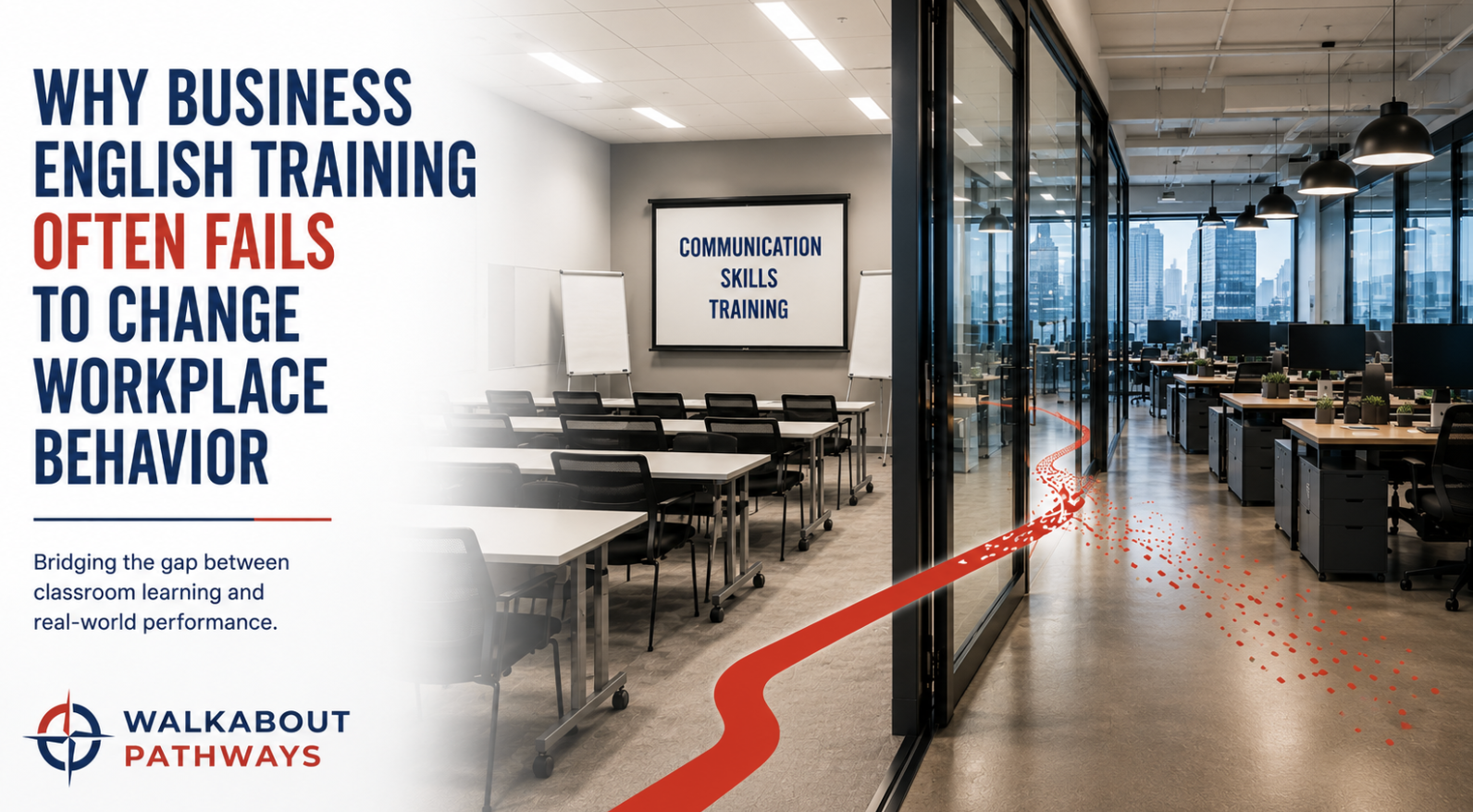
I have taught many classes that appeared successful while they were happening.
Participants were engaged. They completed the activities, contributed to discussions, and performed well during role-plays. Their vocabulary improved, their sentences became more polished, and by the end of the session they could use the communication framework we had practiced. The feedback forms were positive, the training manager was pleased, and everyone gathered for the customary photograph.
From the outside, the course looked like a success. Then the employees returned to work.
The manager who had practiced giving constructive feedback continued avoiding difficult conversations. The employee who had delivered a confident classroom presentation returned to reading paragraphs from PowerPoint slides. Participants who had spoken enthusiastically during role-plays became quiet again when senior leaders entered the meeting.
The learning inside the room may have been real. The trainer may have done good work, and the employees may have made a sincere effort. Yet very little changed where the company actually needed change to occur.
That difference sits at the center of one of the most persistent problems in corporate training.
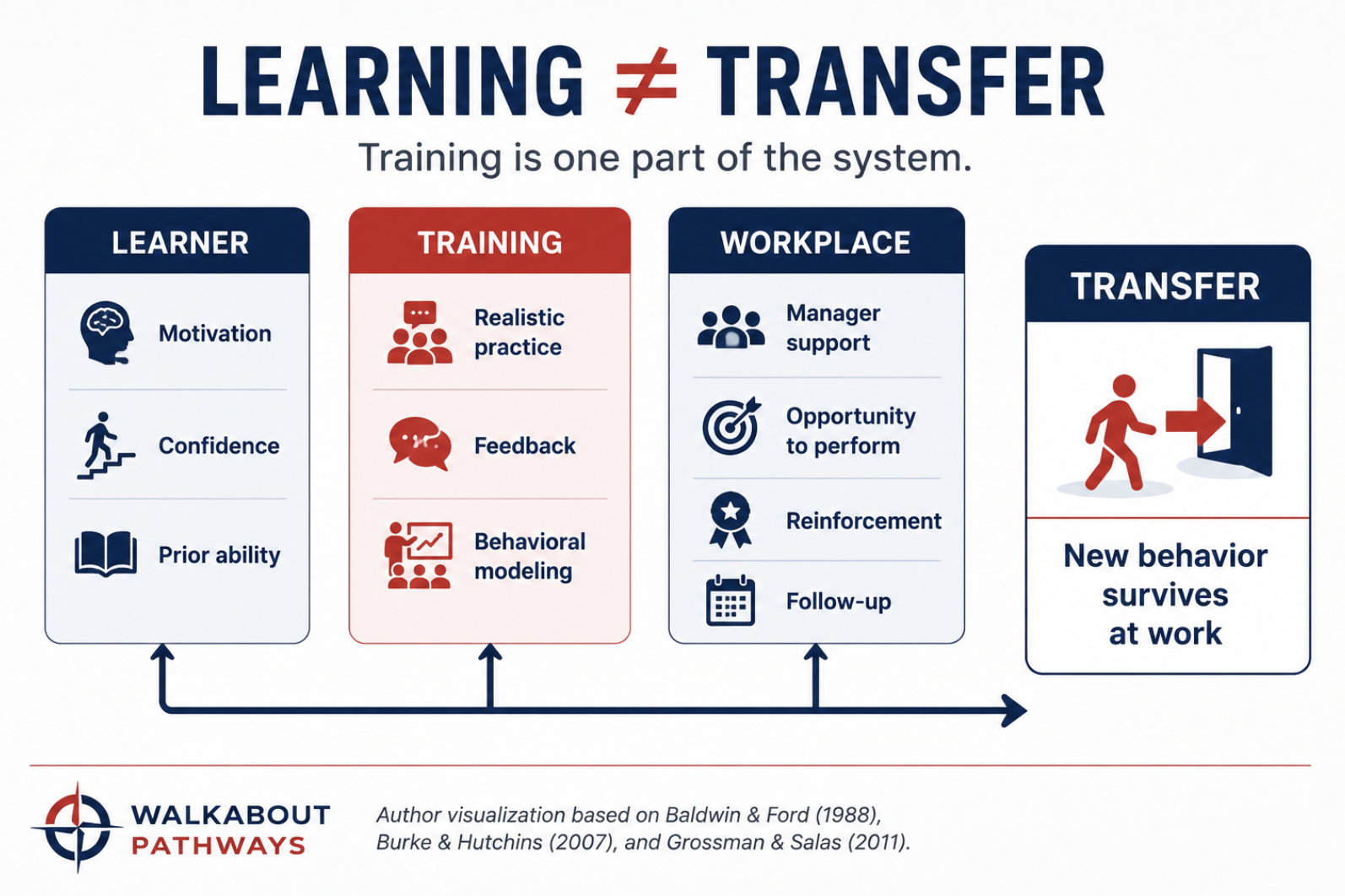
Learning something during a course and using it consistently at work are different achievements. Training researchers describe the second as transfer: the extent to which learning is generalized to the job and maintained over time.

Baldwin and Ford’s influential 1988 model identified three broad groups of factors that shape transfer: characteristics of the trainee, the design of the training, and the work environment. Later reviews have reinforced the same larger lesson. What employees bring into training matters, what happens during the program matters, and what happens when they return to work matters too.
For companies investing in Business English or communication development, that distinction is critical. Attendance, participation, test results, and positive feedback can show that a learning experience occurred. They do not show that workplace behavior changed.
A certificate proves that someone completed training. It does not prove that Monday will look any different.
The classroom is often too far from the work
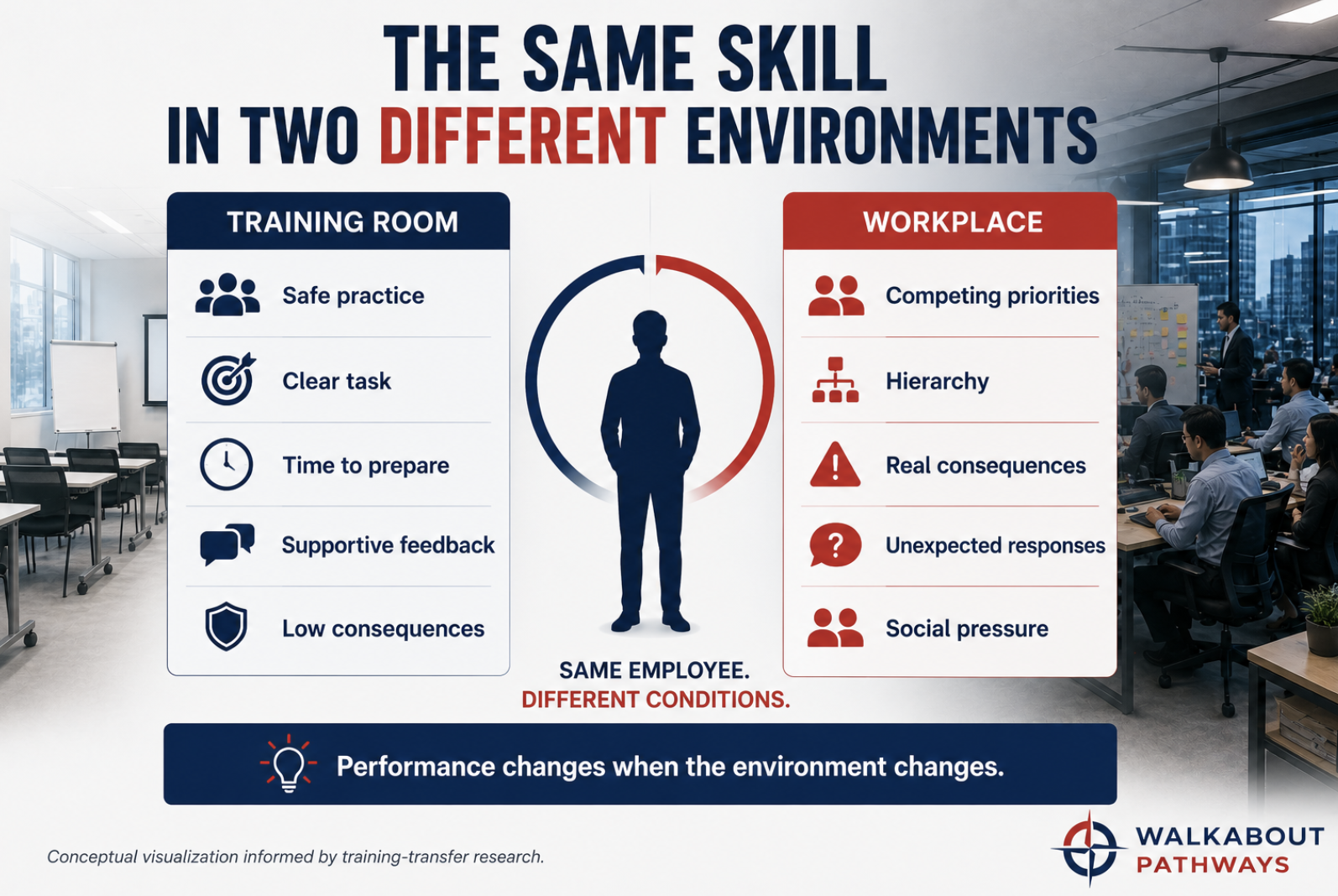
One reason learning fails to transfer is that training activities may resemble the workplace only superficially.
A Business English course might include a unit on meetings. Participants learn phrases for interrupting politely, expressing disagreement, and asking for clarification. They practice using a fictional discussion about choosing an office location or planning an imaginary product launch.
There is value in that. Employees gain vocabulary, structure, and speaking experience.
Their real meetings, however, may involve a dominant senior manager, several departments defending competing interests, incomplete information, cultural tension, and a decision nobody particularly wants to own. Employees may need to challenge an unrealistic target, explain a delay, defend a recommendation, or raise a concern without damaging an important relationship.
The difficult part is rarely remembering the phrase, “I’m afraid I have a different perspective.”
The difficult part is deciding whether to say it, when to say it, how directly to say it, and what to do when the other person pushes back.
Presentations create the same problem. An employee may become comfortable speaking for three minutes about a hometown, favorite product, or imaginary business. That can be useful for fluency and delivery. It does not necessarily prepare someone to present disappointing results to a regional director or recommend an expensive change to skeptical executives.
Employees can become very good at training activities while remaining unprepared for their jobs.
This does not mean every exercise should recreate maximum workplace pressure immediately. Simplified practice can help people develop a skill before greater difficulty is introduced. The problem comes when training never progresses into the decisions, relationships, uncertainty, and consequences that define actual performance.
Grossman and Salas’ review of training-transfer research identified realistic training environments, behavioral modeling, and error-management approaches among the training-design factors showing particularly consistent relationships with transfer. Their review also highlighted workplace conditions such as support, opportunity to perform, transfer climate, and follow-up.
The practical implication is straightforward: at some point, employees need to practice something recognizably close to the work they are expected to perform.
Sales teams should work with real value propositions and common objections. Managers should practice feedback conversations based on situations they actually face. Technical specialists should explain genuine projects to non-specialist audiences. Employees preparing for international meetings should work through the kinds of uncertainty, disagreement, and hierarchy they encounter there.
This approach is less comfortable than generic role-play because the material matters. That is part of its value.
When I coach presentations, people sometimes arrive convinced that their main problem is English or confidence. Once we use an actual presentation, another issue appears. The recommendation may be unclear. The speaker may have far too much information. The structure may make sense to the presenter but nobody else.
A generic speaking activity can hide those weaknesses. Real work tends to expose them.
Professional communication requires decisions, not scripts
Traditional language education understandably places value on correct answers. There is a correct grammatical form, a more suitable word, or a model phrase that participants are expected to produce. Professional communication is much less cooperative.
A manager addressing poor performance has to balance clarity, evidence, timing, respect, and the employee’s likely response. Someone challenging a senior colleague must decide whether to speak publicly, raise the concern privately, ask a question, present evidence, or wait until more information is available. A presenter receiving an unexpected question has to work out what the audience is really asking and how much uncertainty to acknowledge. These are communication decisions, not language answers.
An employee may know several excellent phrases for disagreement and still choose the wrong moment to use them. They may ask a grammatically perfect question that embarrasses a colleague. They may speak clearly while exercising poor professional judgment.
Good communication development therefore needs to include interpretation. Participants should examine situations, consider different responses, anticipate consequences, try an approach, observe what happens, and adjust.
That becomes particularly important in cross-cultural workplaces, where the same behavior may be interpreted differently depending on hierarchy, relationships, workplace norms, and cultural expectations. A direct challenge may be welcomed in one team and regarded as disrespectful in another. Silence may represent agreement, uncertainty, caution, or resistance. A script works beautifully until another person stops following it.
Real colleagues have an irritating habit of doing exactly that. They interrupt. They misunderstand. They become defensive. Clients introduce information nobody expected. A senior manager rejects the recommendation that took three days to prepare and asks for another option before lunch.
Professional communication training has to prepare people to think while communicating rather than simply remember what the lesson told them to say. That requires enough realism for mistakes to become useful information. Participants need opportunities to try something, see the result, receive specific feedback, and attempt it again.
Some of the strongest training moments I have seen were not the polished ones. They were the moments when a manager heard how vague their own instructions sounded, a presenter realized nobody could identify the recommendation, or a fluent employee finally noticed how often they interrupted other people.
Those discoveries matter because they expose a behavior that can actually change.
The workplace can quietly undo the training
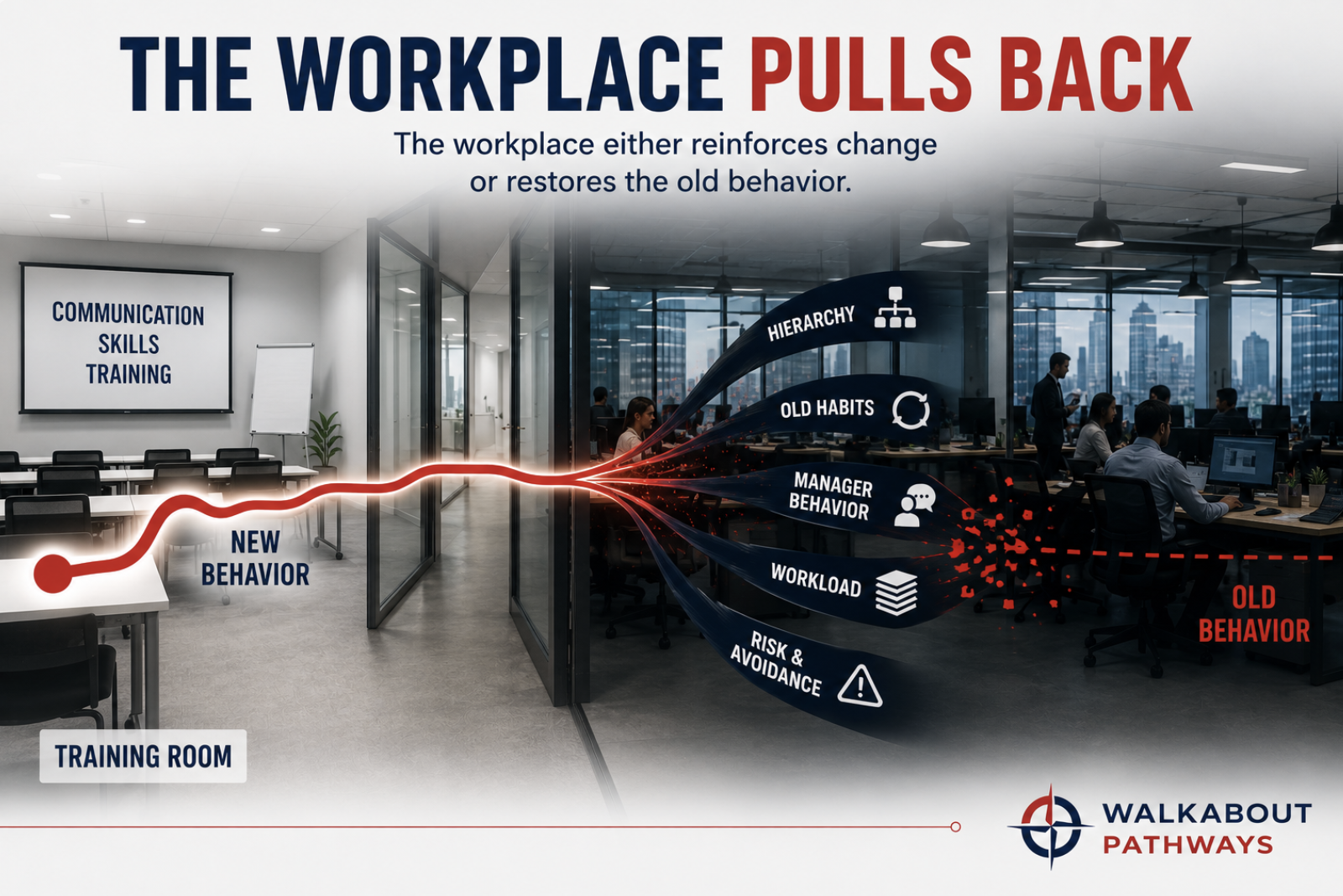
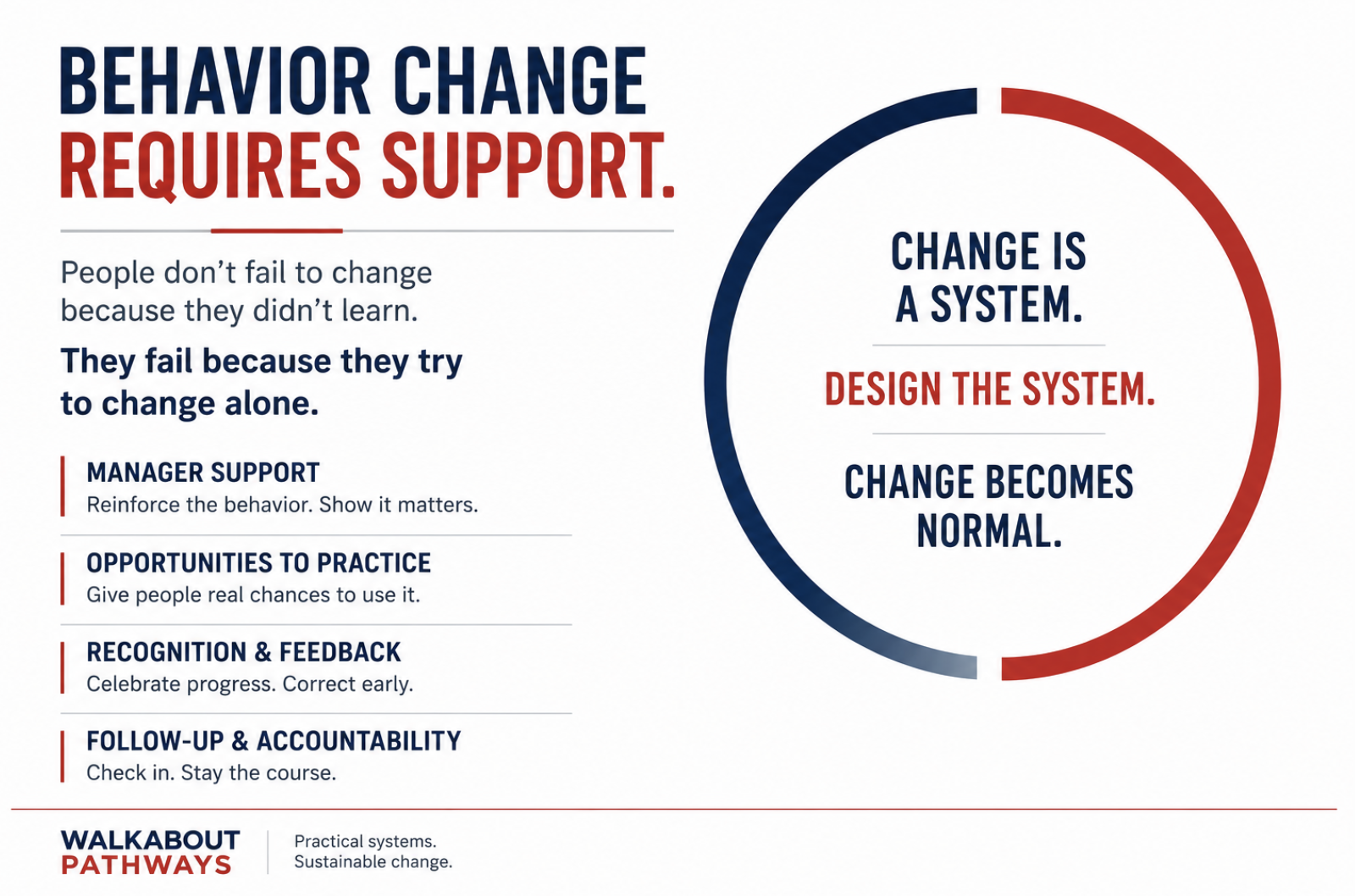
Even excellent training can disappear when employees return to an environment that favors the old behavior.
Imagine an employee learning to contribute more confidently during meetings. During training, they practice organizing ideas, entering conversations, and expressing disagreement professionally. Their performance improves.
Then they return to a meeting where the same senior manager still speaks for most of the hour. Concerns are interrupted. Decisions appear to have been made before the discussion begins, and suggestions from junior employees rarely go anywhere. The employee becomes quiet again.
From the manager’s perspective, the course failed. From the employee’s perspective, silence may be a perfectly rational response. Behavior is shaped by more than ability. Opportunity, leadership, peer behavior, expectations, reinforcement, and the consequences of trying something different all matter. Burke and Hutchins’ review of training-transfer research gives particular attention to supervisory support, peer support, transfer climate, and opportunities to use new learning at work.
Managers are especially important because they control many of those opportunities. They decide who leads a meeting, who presents to a client, who handles a difficult conversation, and what happens when someone makes a mistake while trying a new approach. Yet managers are often almost absent from the development process.
They identify a broad problem, send employees to a course, and wait for improved performance to return. They may know very little about what participants practiced, which behaviors are supposed to change, or what support will be needed afterward. The organization has outsourced development while keeping control of the environment in which that development must survive.
Managers do not need to become trainers. A few practical actions can make a substantial difference: understand what employees are developing, create opportunities for them to use the skill, observe selectively, provide feedback, and ask what is getting in the way.
Peer support matters as well. A new behavior feels less conspicuous when colleagues are practicing similar things. A team can develop clearer meeting habits or presentation standards together rather than leaving one employee to behave differently while everyone else continues as before.
The workplace either helps new behavior become normal or gradually pushes it back out.
Training often ends when practice should begin
The final session is commonly treated as the finish line. Certificates are distributed, feedback forms are collected, and everyone returns to normal responsibilities. There may be no follow-up, coaching, observation, assignment, or structured opportunity to use the skill again. For behavioral development, that timing makes little sense.
The end of formal training is when employees begin discovering whether the new approach survives real pressure. Their first attempts may be uneven. A manager tries a clearer feedback structure but becomes vague when the employee reacts emotionally. A presenter improves the message but struggles during questions. Someone attempts to disagree more directly and creates more tension than expected.
Those experiences are part of learning. Without follow-up, employees are left to interpret them alone. One difficult attempt can convince someone that the new method does not work, and familiar behavior quickly becomes attractive again.
Grossman and Salas identify follow-up and opportunity to perform among the workplace factors with strong and consistent links to transfer. Burke and Hutchins similarly show that transfer emerges from an interconnected set of learner, training-design, and organizational conditions rather than from a single classroom event.
Follow-up does not have to mean another major program. It can include a short coaching conversation, a manager check-in, peer reflection, a recorded presentation, a workplace assignment, or a brief reinforcement session.
The point is continuity. A workshop can introduce a method. It cannot provide every repetition required for that method to become a professional habit. Musicians do not stop practicing after a lesson. Athletes do not assume that understanding a coach’s explanation makes the movement permanent. Communication development deserves the same respect.
Stop measuring what is easiest
Another reason organizations overestimate training success is that the easiest outcomes to measure are usually the most immediate. How many people attended? Did they complete the program? Were they satisfied? Did they pass an assessment? Would they recommend the trainer?
These questions have value. They tell us something about participation and the learning experience. They tell us much less about whether job performance changed. A participant can thoroughly enjoy a workshop and alter very little afterward. Another may find a session uncomfortable precisely because it exposed a habit they genuinely need to address.
Knowledge tests have similar limits. A manager may explain the principles of active listening perfectly and continue interrupting employees the following morning. Knowing what effective communication looks like is different from performing it consistently.
If a company wants behavior to change, evaluation eventually has to return to the workplace. Are employees contributing more clearly during meetings? Are managers having better feedback conversations? Are presentations organized around decisions instead of information dumps? Can employees handle client discussions with greater independence? Are teams experiencing fewer avoidable misunderstandings?
Those indicators are harder to collect than attendance figures. They are also much closer to the reason the organization paid for training in the first place. Ideally, they should be defined before the program begins. If leaders cannot describe what better performance would look like, determining whether training worked will always be difficult.
The standard should be what happens after the course
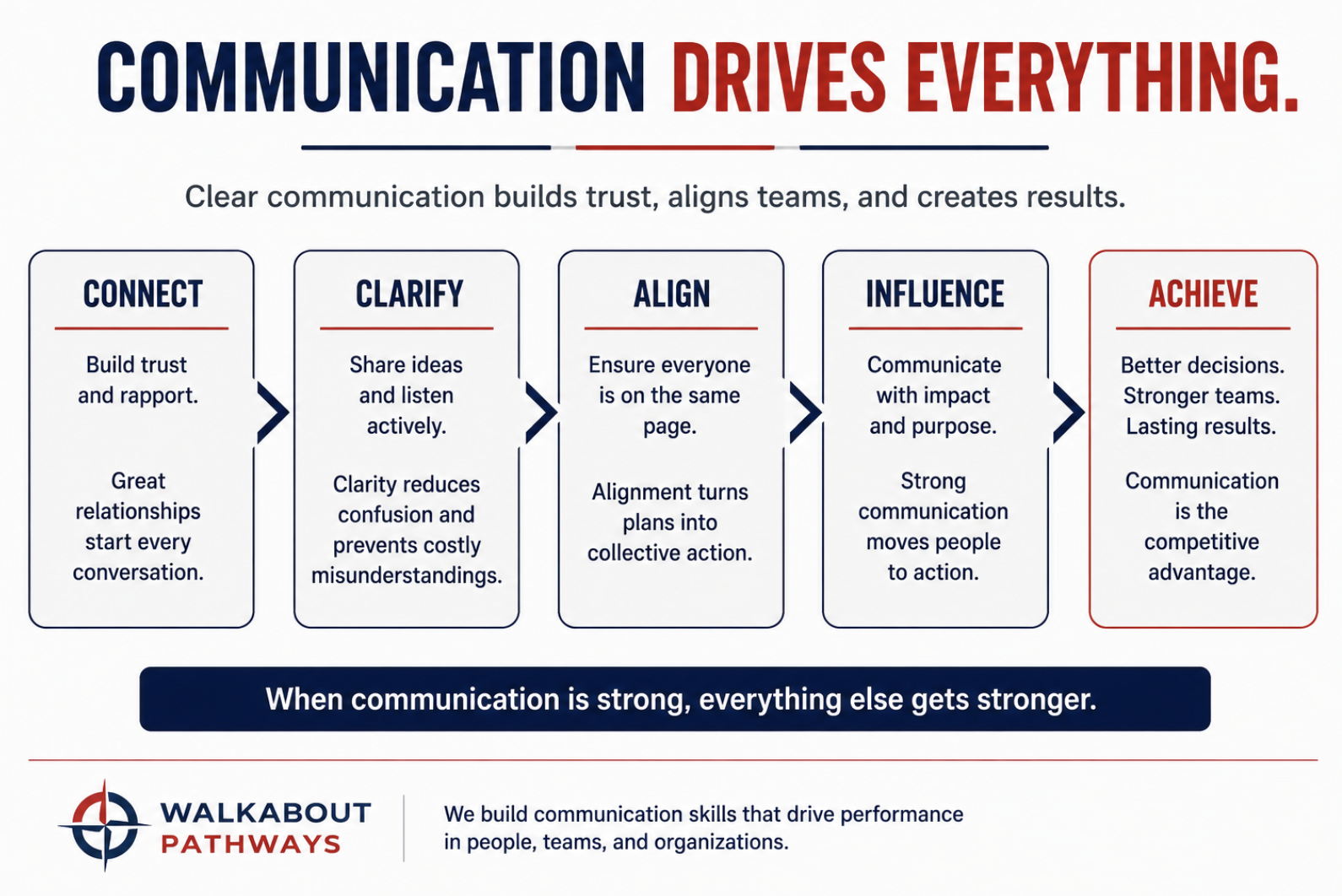
Business English training does not fail because language teaching has somehow become obsolete. Language development remains valuable wherever employees genuinely need it. The problem appears when companies expect a classroom event to transform workplace behavior without creating the conditions that allow the learning to transfer.
Training may be too distant from actual work. Employees may practice model answers instead of professional decisions. Managers may remain outside the process. Participants with different roles and needs may receive the same activities. The program may finish before workplace application really begins, and success may be judged through satisfaction rather than performance.
Making the slides prettier will not solve those problems.
A stronger process begins with the work itself. What situations matter? What should employees be able to do differently? What makes that difficult now? How closely can practice resemble the real task? What opportunities will employees have to use the behavior afterward? Who will support them, and what evidence will show that improvement occurred?
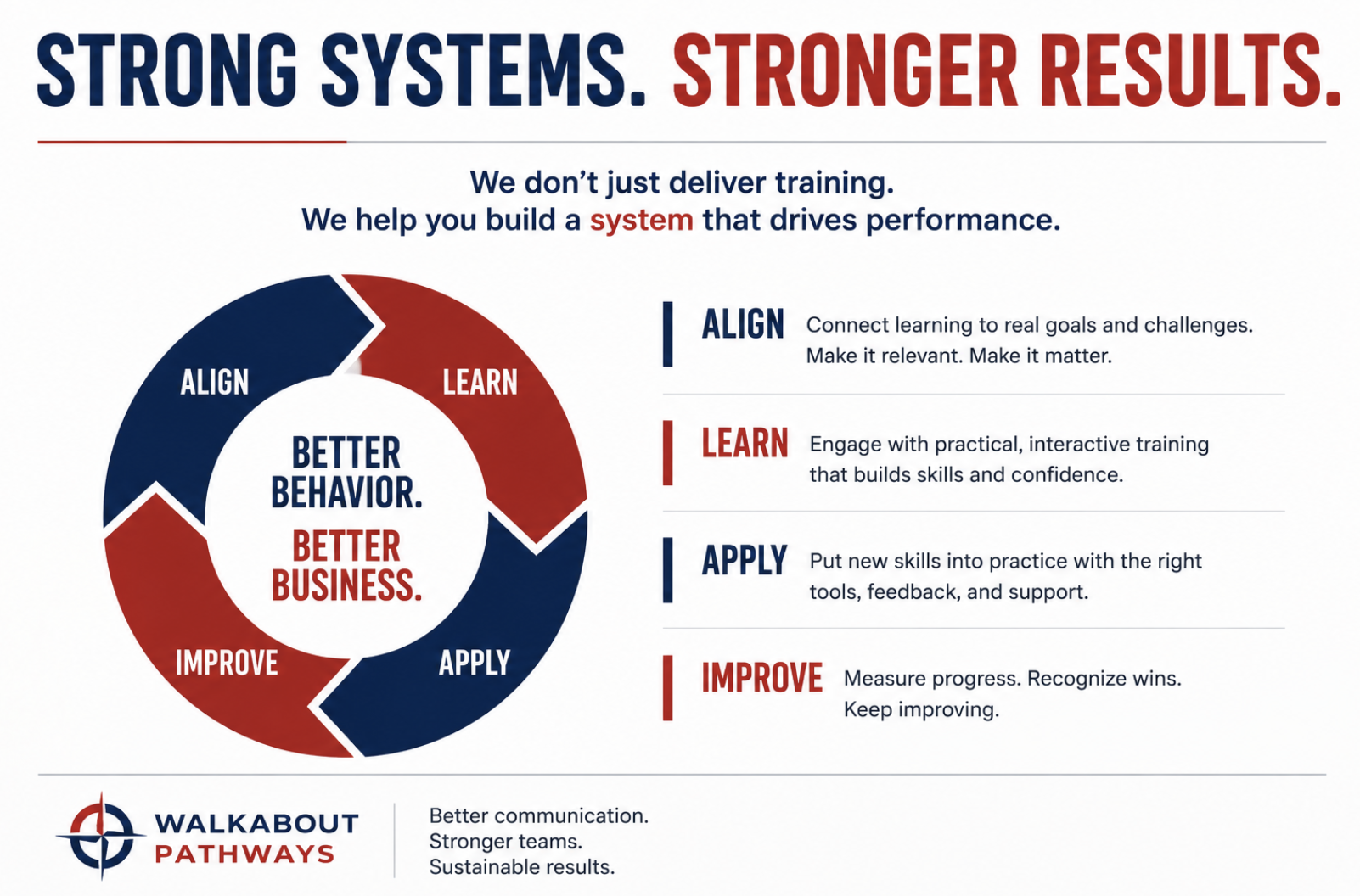
At Walkabout Pathways, this is why we think of communication development as a process rather than a classroom event. Shared workshops can introduce concepts and provide practice, but employees also need role-specific application, individual feedback, realistic pressure, and enough connection to the workplace for learning to survive beyond the training room.
Some employees may need English support. Others may need work on presentation structure, leadership communication, confidence, listening, or cross-cultural interaction. The intervention should follow the behavior that needs to change rather than assume that one course can solve everything.
The objective is not to help employees perform well during training. It is to help them perform differently afterward. Companies invest in development because they want something in the work to change: a clearer meeting, a better management conversation, a stronger presentation, or a more independent client interaction.
That change does not happen when the certificate is printed. It happens when a new behavior survives contact with the workplace and gradually becomes part of how the person works. That is the standard corporate training should be judged against.
About the Author
Paul Allen Benavides is a university lecturer in business and media, corporate trainer, speaker, MC, author, YouTuber, and podcast host. He is the co-founder of Walkabout Pathways. His professional work focuses on communication, public speaking, leadership presence, workplace learning, and cross-cultural collaboration. His doctoral research examines trust, professional relationships, and value creation within place-based international business ecosystems.
