The Problem with Teaching Every Employee the Same Curriculum
I have walked into many corporate classrooms where the participants had already been organized into a neat group before anyone had worked out what each person actually needed.
They belonged to the same department, held similar job titles, or had received comparable scores on an English placement test. From an administrative perspective, the arrangement made perfect sense: twelve employees, one trainer, one schedule, one room, and one curriculum. Everyone would study the same material for the same number of hours and, in theory, improve together.
Then the introductions began. One employee struggled to form basic sentences and genuinely needed foundational English. Another spoke comfortably but could not organize a presentation. A third understood almost everything yet became quiet whenever a senior manager entered the room. Someone else worked regularly with international clients and needed help handling disagreement and cultural differences. At the other end of the table was the fluent, energetic participant who contributed to every discussion, usually before anyone else had finished speaking.
They had all been given the same diagnosis an all been given the same course. The curriculum rarely survived first contact with the people.

The cohort can hide the individual
Grouping employees is not inherently a problem. Shared training can create common language, introduce useful frameworks, and give colleagues opportunities to learn from one another. It is also economically practical. Few organizations can provide every employee with a completely individual development program.
The problem begins when administrative convenience becomes a theory of learning.
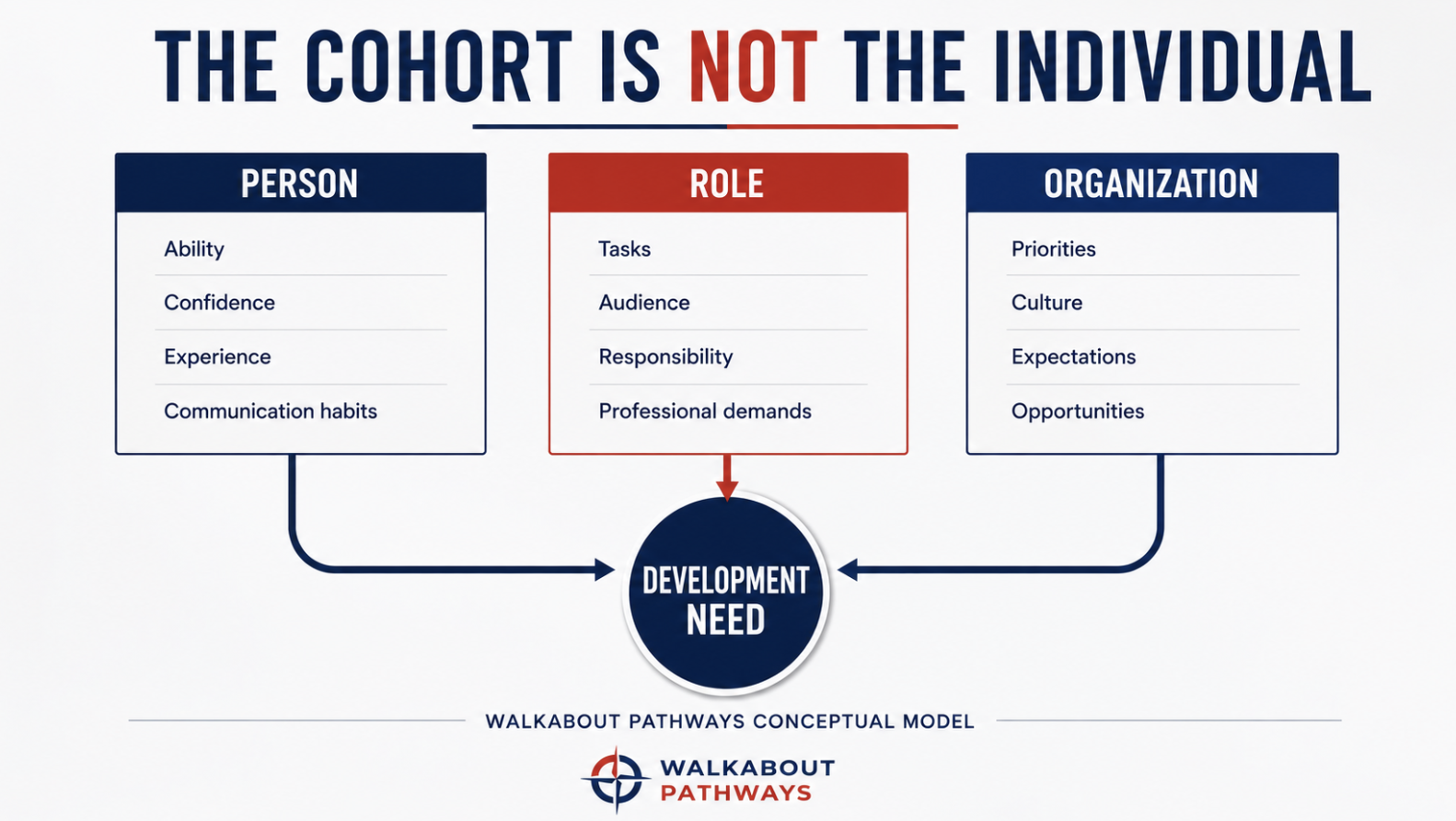
Ten employees may work in the same department while facing very different communication demands. They may differ in English proficiency, confidence, experience, responsibilities, cultural exposure, professional goals, and the situations in which they are expected to perform. Even employees with the same job title may use communication differently depending on their clients, projects, seniority, or future responsibilities.
A placement score tells us something about language proficiency. It tells us much less about whether someone can explain a complex recommendation, lead a difficult meeting, give feedback, manage disagreement, listen effectively, or present to senior management.
This distinction is consistent with research on training-needs analysis. A 2025 systematic review covering 101 scientific publications found that needs analysis is strategically important but is often conducted unsystematically, with excessive attention to individual-level gaps and insufficient connection to organizational strategy. The larger lesson is that development needs cannot be understood from one measure alone.
A useful diagnosis has to connect the person, the work, and the organization.
Similar employees may need very different things
Consider five people placed into the same Business English course.
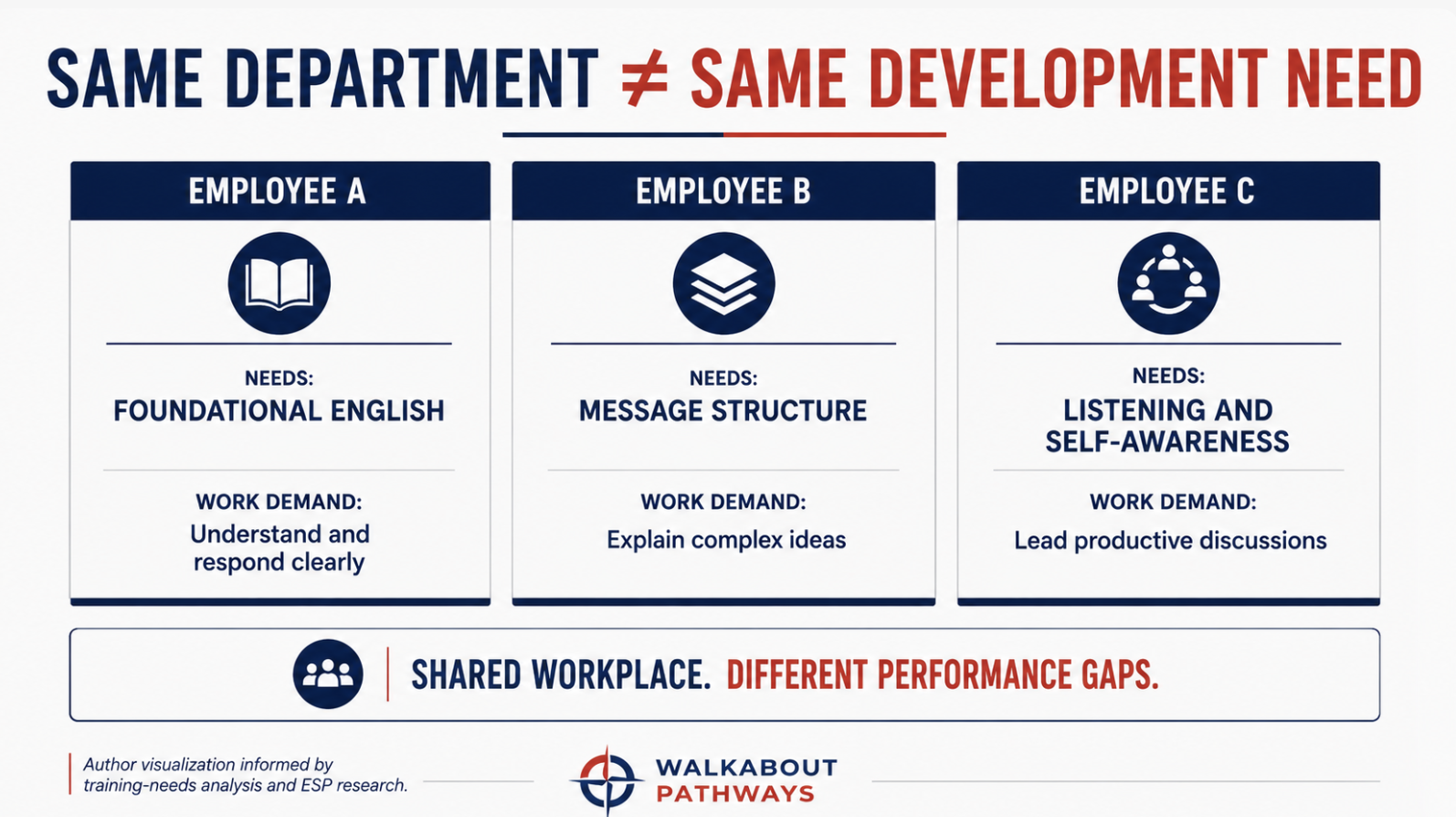
The first has limited vocabulary and struggles to follow normal-speed conversation. That employee needs genuine language development and enough time to build it.
The second speaks English comfortably but struggles to explain complicated ideas. Their problem is less about vocabulary than structure. They need to decide what matters, organize evidence, remove unnecessary detail, and make the main point easier to follow.
The third knows what they want to say but hesitates because they are afraid of making mistakes. Their English may already be functional. Years of monitoring every sentence have simply taught them to wait until they feel completely certain, which is usually about three minutes after the conversation has moved on.
The fourth communicates confidently with colleagues but struggles with international clients. They may need greater awareness of tone, indirect language, expectations, hierarchy, and cultural interpretation.
The fifth is the strongest English speaker in the group. They speak quickly, use sophisticated vocabulary, and volunteer for everything. A conventional language assessment might identify them as the strongest communicator. Their colleagues may have a different opinion because they interrupt constantly, rarely ask questions, and appear to regard silence as an emergency that must immediately be filled.
That person probably does not need more fluency. They need better listening and greater awareness of their impact on other people.
Giving these five employees exactly the same curriculum may provide each of them with something useful. It is unlikely to address the most important development need for all five.
The job matters as much as the language level
Department labels create a similar illusion.
A hotel may group front-office employees together because they all interact with guests. Yet one employee handles routine check-ins, another resolves complaints, and a supervisor manages difficult situations while coordinating several departments. Their work overlaps, but the communication demands differ considerably.
The same is true in technology, finance, manufacturing, universities, and professional services. A technical specialist may need to translate complex information for non-specialists. A manager needs to delegate, give feedback, and address performance. A salesperson needs to uncover needs and handle objections. A senior leader may need to communicate direction during uncertainty.
All of them might benefit from presentation training. They should not necessarily give the same presentation.
English for Specific Purposes has long been built around this idea. Needs analysis is central to ESP because language development should reflect the communication requirements of the environment in which learners actually need to function. Basturkmen describes needs analysis as closely tied to the design and ongoing revision of programs for particular professional and academic settings.
More recent ESP scholarship continues to emphasize work-related linguistic needs and the specialized language people require in target settings. That principle should extend beyond language. If employees are being developed for professional communication, the training should resemble the communication their jobs require.
A sales employee could practice pitching an actual service. A technical specialist could explain a current project to a nontechnical manager. A supervisor could rehearse an upcoming change conversation. The framework might be shared across the group, but the application belongs to the employee.
Generic practice can introduce a skill but real work reveals whether the person can use it.
The “average participant” does not exist
Standard curricula are attractive because they make training easier to buy and deliver. A provider can prepare one proposal, one set of materials, and one schedule. HR can approve a common budget and place employees into a cohort. Progress can then be reported through attendance, assignments, or assessment scores.
The process is tidy. People are not.
As development moves beyond foundational knowledge and into communication, leadership, confidence, judgment, and interpersonal behavior, individual differences become increasingly important. Two employees may both need to improve presentations, for example, while requiring almost opposite interventions.
One may need permission to speak more freely. The other may need to discover that an audience does not require every thought they have ever had on the subject. One employee who speaks quietly may lack confidence. Another may be uncertain about the material. Another may be responding to hierarchy. Another may simply have a naturally quiet voice.
The visible behavior is similar but the cause is not.
This is why diagnosis matters before curriculum design. Competency-based approaches can help organizations compare the capabilities required for particular work with current performance and identify where development is needed. Research on competency-based training-needs assessment supports its use as one method of connecting required competencies with training priorities.
That does not mean every employee requires a psychological investigation and a thirty-page report before attending a workshop. Assessment should be proportionate to the investment.
A short session may require only a focused conversation with managers and participants. A six-month development program deserves a deeper understanding of roles, performance, and organizational priorities.
The principle is simple: the larger the investment, the weaker the excuse for guessing.
Standardization can favor the people who already perform well
There is another problem with treating the cohort as one learner. In mixed groups, confident and fluent employees often speak first, volunteer more frequently, and receive more direct feedback. Quieter participants contribute less because they require additional processing time or because the same few people have already occupied the available space.
The room may look energetic while three people are doing most of the talking. This can create the strange outcome in which employees who need the most practice receive the least.
The strongest speaker may also conceal a communication problem. Someone who talks frequently is easy to notice, but visibility is not the same as effectiveness. A quieter employee may listen more carefully, form better ideas, and contribute with greater precision. The fluent participant may generate energy while simultaneously preventing everyone else from participating.
Communication development therefore needs to examine impact, not simply volume.
The same curriculum can also feel very different depending on the employee. Someone who feels psychologically safe may experiment with a new behavior. Someone who expects embarrassment, interruption, or criticism may remain cautious even after learning exactly what to do.
Personalization does not mean twelve separate courses
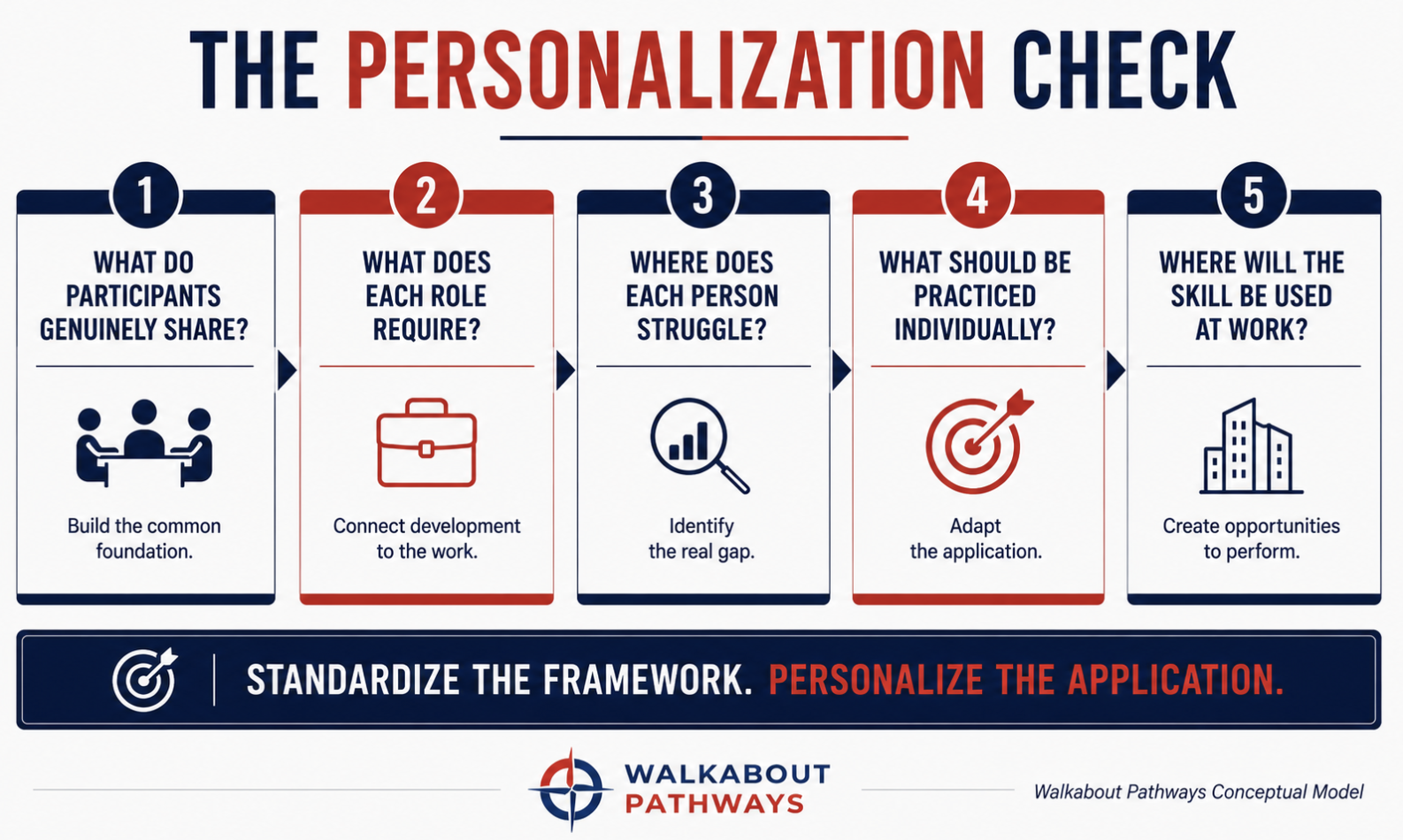
This is where discussions about individualized development often become unnecessarily dramatic. Personalization does not mean twelve employees require twelve private trainers, twelve curricula, and twelve inspirational soundtracks. A strong program can combine common learning with individual application.
The group might learn a shared framework for presentations, listening, meetings, feedback, or professional presence. Those common sessions create vocabulary and expectations that colleagues can use together.
Then each participant applies the framework to something relevant. The analyst presents a recommendation based on current data. The manager explains a proposed change. The salesperson handles a real customer objection. The technical specialist explains a complex process for a nontechnical audience.
Individual priorities can also remain simple. Each participant might identify two development goals rather than receiving a catalog of everything they do imperfectly. One person focuses on concise message structure. Another works on entering conversations earlier. Another practices listening without interrupting. Another develops greater comfort answering unexpected questions. Focused development is easier to practice, observe, and reinforce.
Training has to connect to opportunity
Personalization also means recognizing that development cannot occur entirely inside the classroom.
An employee cannot become better at leading meetings if they are never allowed to lead one. A future manager will not develop feedback skills if every difficult conversation is handled by someone senior. Someone can practice presentations repeatedly during training and make little progress if their actual role never requires them to speak.
Managers therefore have a role in development. They need to understand what employees are practicing and create reasonable opportunities to apply it. Feedback can then move from the hypothetical to the observable: What happened in the meeting? Was the recommendation clearer? Did the employee enter the discussion earlier? Did the manager listen differently?
This is where individual development becomes organizational capability. The employee practices something useful. The manager notices and reinforces it. The team gradually develops new expectations about how work should be communicated. Without that connection, personalization can become another development plan saved in a folder and rediscovered six months later when somebody is cleaning the shared drive.
Build around what people share, then respect the differences
There is still a strong case for group learning. Employees learn from watching one another. Cohorts can build trust and create shared standards. A common framework can make communication easier to discuss across teams. Group practice also reflects the reality that professional communication is social. People rarely communicate at work entirely by themselves.
The aim should be to stop confusing the cohort with the individual, not to eliminate the cohort.
A strong program begins by identifying what participants genuinely have in common. Those shared needs become the foundation. The design then allows enough flexibility for different roles, abilities, and behaviors to appear within that structure.
At Walkabout Pathways, this is one reason we favor an assessment-led approach to communication development. A common program can provide the core, while role-specific practice, observation, coaching, and individual feedback address the needs that do not belong to everyone. Sometimes the assessment may reveal that several employees genuinely need more English. Others may need presentation structure, leadership communication, listening, confidence, or cross-cultural support. The point is not to make the solution complicated for its own sake.
The complexity already exists in the people. Instead of beginning with, “What course should this department take?”, organizations would be better served by asking: “What must these people be able to do, and where does each person currently need support?”
The answer may still lead to a common program. It may also produce several development pathways within one program.
Some employees need more language. Some need stronger structure. Some need confidence. Some need better listening. Some need greater cultural awareness. Some need to speak more, while others would benefit from the revolutionary professional practice of allowing somebody else to finish a sentence.
Teaching them all exactly the same thing may be efficient to administer. Developing them around what they actually need is more likely to change how they work. Companies do not employ cohorts. They employ individuals who have to work together. Their training should remember both.

About the Author
Paul Allen Benavides is a university lecturer in business and media, corporate trainer, speaker, MC, author, YouTuber, and podcast host. He is the co-founder of Walkabout Pathways. His professional work focuses on communication, public speaking, leadership presence, workplace learning, and cross-cultural collaboration. His doctoral research examines trust, professional relationships, and value creation within place-based international business ecosystems.
