English Fluency Is Not the Same as Professional Communication
Some of the most confusing conversations I have experienced in international workplaces involved people who spoke excellent English.
Their grammar was accurate, their vocabulary sophisticated, and their pronunciation clear. They could speak quickly without searching for words. On paper, and often in an interview, they looked like highly capable communicators.
Then the meeting began.
One person spoke for fifteen minutes without establishing a clear point. Another answered every question except the one that had actually been asked. A manager delivered instructions that sounded polished but left the team uncertain about what should happen next. Someone else used so much technical language that half the room stopped listening while continuing to nod with admirable professionalism.
Nobody had a meaningful English problem. Everyone understood the words. The communication still failed.
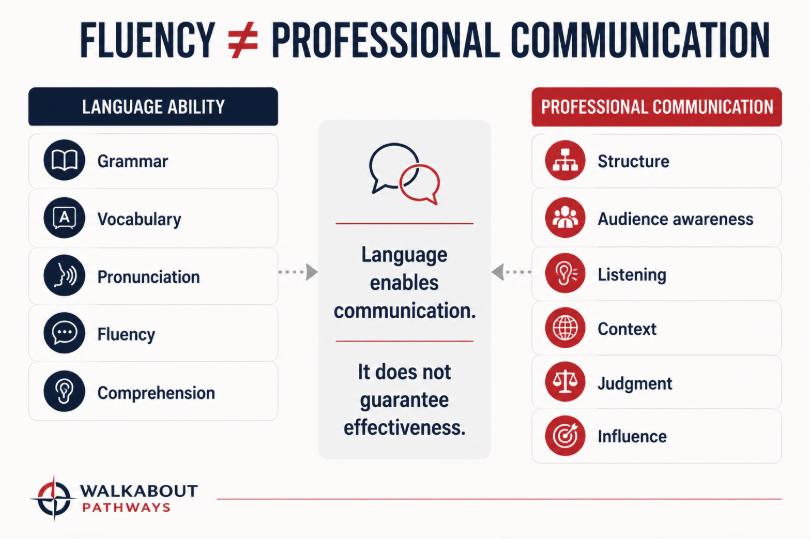
That distinction matters because language ability is relatively easy to measure. We can test grammar, vocabulary, listening, reading, pronunciation, and fluency. We can assign levels, issue certificates, and compare scores. Professional communication is harder to capture because it depends on what a person does with language in a particular situation, with a particular audience, and under a particular set of pressures.
After years of teaching, managing, presenting, interviewing people, and working across the United States, China, and Vietnam, I have become increasingly skeptical of the assumption that more fluent English automatically produces better professional communication. Greater proficiency certainly helps. It gives people more vocabulary, stronger comprehension, and more freedom to express complicated ideas.
But fluency does not automatically teach someone how to organize a recommendation, adapt to an audience, handle disagreement, read cultural signals, ask useful questions, or influence a decision. Those are communication abilities. Language makes them possible, but language alone does not create them.
Fluency does not guarantee clarity
I have watched professionals deliver presentations in English that were almost entirely correct and still remarkably difficult to follow. The speaker knew the subject, understood the terminology, and had clearly prepared. Usually, the problem was not too little information. It was too much of it, badly arranged.
The presentation began with background, moved into more background, introduced several definitions, displayed a crowded chart, and continued through a long procession of details. Somewhere near the end, the speaker finally mentioned the recommendation, almost casually, as though hoping the audience might discover it without assistance.
When the presentation finished, everyone had learned something, but nobody was entirely sure what they were being asked to decide.
This is less a language problem than a problem of structure and judgment. People often organize messages according to the order in which they learned the information rather than according to what the audience needs. They begin with everything they know and slowly work their way to the point.
Strong professional communicators make different choices. They decide what matters first, what the audience needs to understand, and which details deserve to survive the editing process. A presentation, meeting contribution, or written recommendation is not an exhibition of everything stored inside the speaker’s head. It is an act of selection.
A person may know ten ways to describe a problem and still fail to explain which problem matters most. They may possess advanced vocabulary yet struggle to say, in effect, “This is what I recommend, this is why, and this is what we need to do next.”
The distinction between knowing a language and using it appropriately has been discussed for decades. Dell Hymes introduced the idea of communicative competence partly in response to approaches that treated language ability mainly as knowledge of grammatical rules. Canale and Swain later developed a model that included grammatical, sociolinguistic, and strategic competence. Michael Canale subsequently identified discourse competence as a distinct fourth component, drawing attention to how individual sentences connect into coherent spoken and written messages.
The practical lesson is straightforward: grammatically correct sentences can still be badly organized, poorly timed, inappropriate for the audience, or irrelevant to the decision at hand.
Senior leaders, for example, rarely need every detail of a process before hearing the conclusion. They usually want to understand what has happened, why it matters, what options exist, what is recommended, and what decision is required. An employee who struggles to structure that sequence may be described as lacking confidence or executive presence. They may even be sent for more English training.
The problem may have nothing to do with vocabulary. The words simply have not been given a clear job.
The audience and context change the message
Professional communication changes according to who is listening.
A finance analyst speaking with another analyst can use specialized terminology with little explanation. The same person presenting to a general manager may need to focus on business implications. Speaking with a customer requires another shift because the information needs to connect with the customer’s concerns rather than the analyst’s preferred method of calculation.
The facts may stay the same. The communication should change.
This ability to adapt is one of the clearest differences between fluency and professional communication. Fluent speakers can become attached to the way they naturally explain something. Effective communicators pay attention to whether that explanation is working for the person in front of them.
They notice confusion, adjust the level of detail, replace jargon with examples, and decide what can safely be removed. Simplifying an idea does not make it simplistic. Often, simplification is evidence that the speaker understands the subject well enough to separate what matters from what does not.
I see the opposite frequently in university classrooms. Students sometimes present as though the audience already knows everything they know. They borrow terminology directly from academic articles, fill slides with definitions, and use formal language because it sounds intelligent. The result can become a performance of knowledge rather than an effort to create understanding.
Professionals do this too, particularly when they feel uncertain. Complicated language can feel protective. It creates an appearance of expertise and reduces the risk of sounding too simple. Unfortunately, it also increases the chance that the audience leaves without knowing what should happen next.
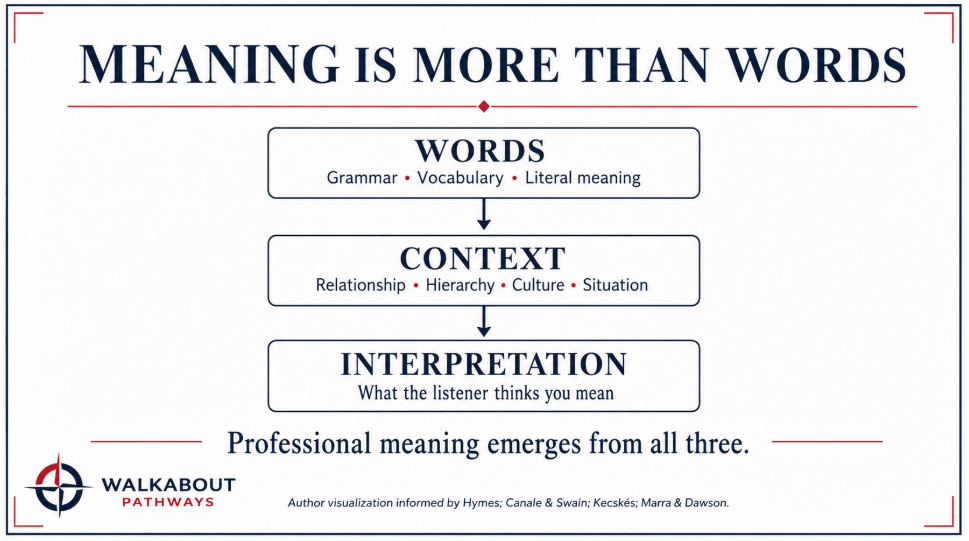
Context adds another layer because people can understand the same sentence and still interpret it differently.
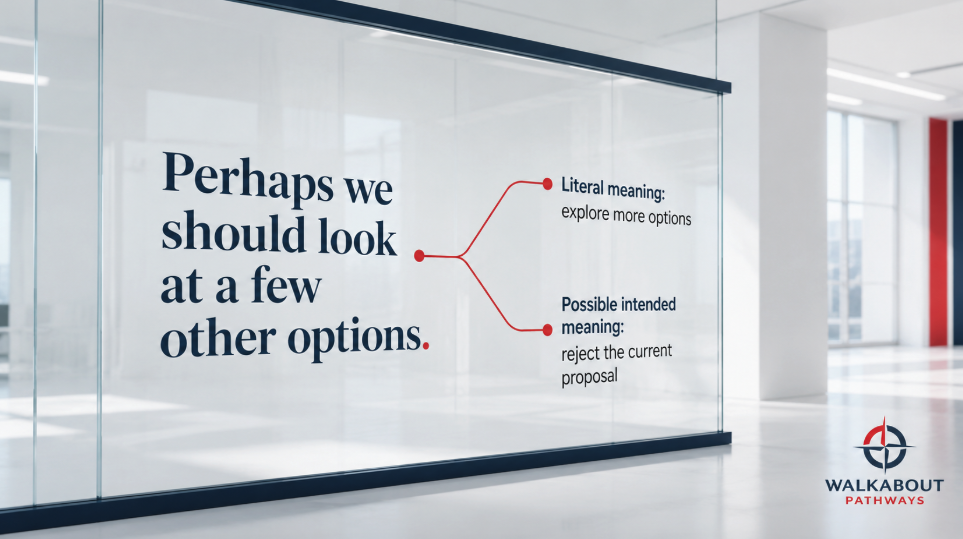
Imagine a senior manager saying, “Perhaps we should look at a few other options.” Literally, the statement suggests that more options should be considered. In practice, the manager may be politely rejecting the proposal. An employee who focuses only on the words may continue developing the same idea. Someone more familiar with the context may understand that the discussion has already moved on.
The reverse can happen as well. A manager accustomed to direct communication may interpret a careful, indirect response as evasive. The employee may believe they are showing tact and respect. Neither person lacks English. They are using English through different professional and cultural expectations.
Pragmatic competence helps explain this. It concerns the ability to understand and use language appropriately in social situations, including indirect meaning, intention, politeness, relationships, and context. Research on workplace discourse similarly shows that professional meaning is shaped by organizational goals, hierarchy, relationships, cultural expectations, and the interactional setting in which language is used.
I have encountered this repeatedly in international workplaces. A foreign manager may invite open discussion and assume that silence means agreement. Vietnamese employees may remain quiet because publicly challenging the manager feels inappropriate, especially when the manager has already made a preference clear.
The meeting ends with what looks like consensus. Later, the plan encounters resistance, delay, or quiet non-compliance. The manager concludes that employees were not honest. Employees conclude that the manager never created a realistic opportunity to disagree.
Everyone used English. The shared language concealed the absence of shared expectations.
In my own work across different countries, I have encountered recurring differences in how people interpret directness, hierarchy, relationship-building, and disagreement. Some American colleagues have valued speed and direct expression, while Vietnamese or Chinese colleagues I have worked with have sometimes placed greater weight on hierarchy, relational context, or indirect communication.
These observations become dangerous when converted into cultural formulas. Individuals vary enormously, and workplaces develop their own norms. Cultural awareness is useful because it encourages curiosity rather than certainty. Better questions are situational: How is disagreement expressed here? Who is expected to speak first? What does silence mean in this team? Can junior employees question senior leaders safely?
Those are not really English questions. They are questions about human interaction conducted through English.
Pressure reveals communication quality
Few situations expose the difference between fluency and professional communication faster than pressure.
A person may speak comfortably in casual conversation and struggle as soon as status, money, responsibility, or competing ideas enter the discussion. Some people become silent. Others become defensive, vague, overly direct, or personal.
Organizations sometimes describe capable employees as lacking authority or presence. Limited fluency can contribute to that impression, particularly when hesitation or repetition makes someone appear less certain than they actually are. But authority also depends on structure, preparation, delivery, judgment, and the speaker’s relationship with the audience.
Someone who hides the recommendation beneath five minutes of explanation may appear uncertain even when they feel confident. A manager who ends every instruction with “maybe” or “if possible” may create ambiguity while trying to sound polite. At the opposite extreme, a fluent speaker may confuse authority with volume, interrupt constantly, and fill every silence.
Confidence is visible. Influence is something else.
Speaking with authority means making a clear contribution that suits the role and situation. It also requires listening. Professional listening is more than waiting quietly for another person to stop speaking. It involves attention, interpretation, clarification, and the possibility that new information may change your position.
The questions people ask often reveal the quality of that listening. A manager might ask, “Do you understand?” and receive the predictable yes. A better question might be, “What do you think the next step should be?” or “What concern have we not considered?” The first checks compliance. The others create information.
Disagreement raises the stakes further. Language training can provide useful phrases such as “I’m afraid I have a different perspective,” but phrases do not create judgment. A person still needs to identify the actual point of difference, explain their reasoning, listen to the response, and adjust the level of directness to the relationship and stakes.
They also need to understand the purpose of the conversation. Are they trying to correct an error, improve a proposal, protect a relationship, influence a decision, or simply prove that they are right? That final objective remains surprisingly popular and rarely improves the meeting.
In international workplaces, disagreement becomes more delicate because the same behavior can carry different meanings. A direct challenge may signal engagement in one environment and disrespect in another. Indirect language may signal diplomacy to one listener and avoidance to another.
Research on pragmatic competence helps explain why these mismatches can become personally costly. When grammatically acceptable language is interpreted differently from what the speaker intended, listeners may attribute the problem to character rather than communication. Someone may be judged rude, weak, evasive, arrogant, or untrustworthy when they are applying norms learned somewhere else.
This is why communication development needs realistic practice. People need to experience disagreement, interruption, ambiguity, hierarchy, and unexpected responses. Perfectly scripted role-plays reveal very little because everyone knows what is supposed to happen.
Real work is less cooperative. Practice becomes useful when it is realistic enough for people to notice what they actually do.
Professional communication should move decisions forward
The purpose of workplace communication is rarely to demonstrate language ability. It is to coordinate action, build understanding, protect relationships, solve problems, and influence decisions.
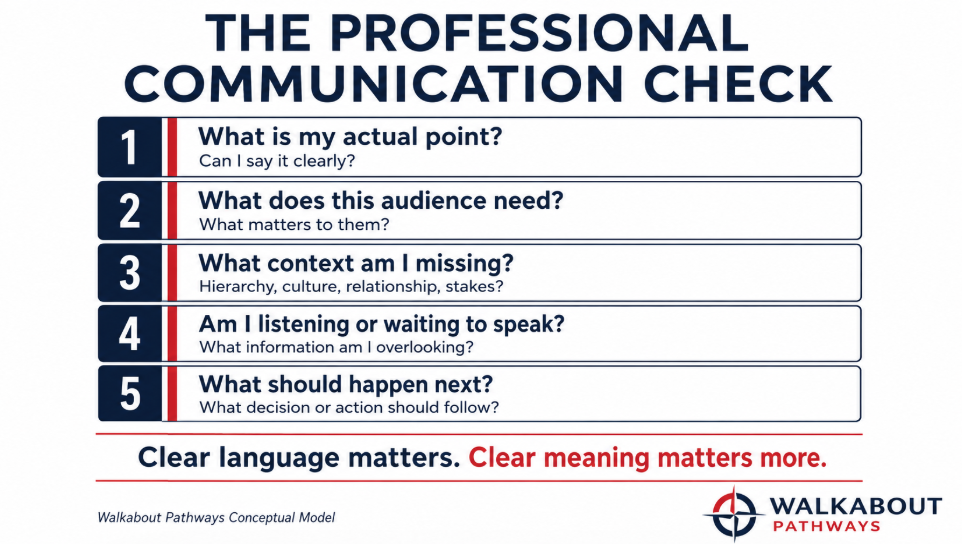
A person may speak beautiful English and contribute very little to any of those outcomes. They may provide information without making a recommendation, describe a problem without explaining why it matters, present several options without clarifying the trade-offs, or speak confidently while ignoring the evidence the audience actually values.
This is where communication becomes difficult to separate from thinking.
Poorly organized speech often reflects an idea that has not yet been fully organized. I have seen this repeatedly while coaching presentations. A speaker asks for help with confidence or delivery, but after a few questions it becomes clear that they are still unsure what they want the audience to believe or do.
Their nervousness makes sense. It is difficult to sound confident about an argument that has not finished becoming an argument.
Once the message becomes clearer, the delivery often improves with it. The speaker needs fewer memorized lines because they understand where the argument is going. Confidence grows from having something coherent to say.
This is one reason communication development should stay close to the work itself. Employees need to practice with real decisions, recommendations, objections, audiences, and stakeholders. Generic speaking topics may improve fluency, but they reveal far less about whether someone can communicate effectively in the role they actually perform.
At Walkabout Pathways, this distinction shapes how we approach communication development. English proficiency may be part of the need, but we also look at how people organize ideas, adapt to audiences, listen, handle pressure, interpret context, and contribute to decisions.
The objective is not to make everyone sound like a native English speaker. That is unnecessary and, in an international workplace, often irrelevant. The objective is to help people communicate clearly, credibly, and appropriately in the situations their work requires.
A professional with modest English can become an excellent communicator by organizing ideas well, listening carefully, asking useful questions, and making the purpose of the message clear. A fluent speaker can remain ineffective if they ignore the audience, avoid difficult conversations, speak without structure, or confuse confidence with influence.
Companies should continue supporting English development where it is genuinely needed. They should simply stop treating fluency as the finish line.
English gives people access to the conversation. Professional communication determines what happens once they are in it.
About the Author
Paul Allen Benavides is a university lecturer in business and media, corporate trainer, speaker, MC, author, YouTuber, and podcast host. He is the co-founder of Walkabout Pathways. His professional work focuses on communication, public speaking, leadership presence, workplace learning, and cross-cultural collaboration. His doctoral research examines trust, professional relationships, and value creation within place-based international business ecosystems.
